
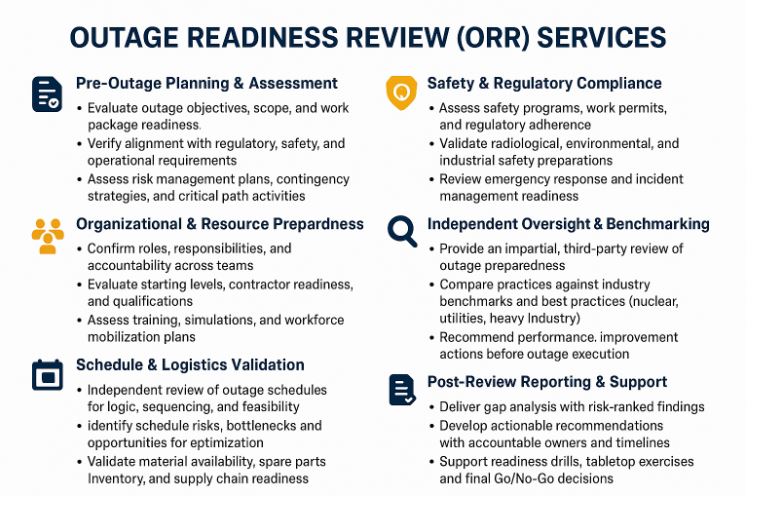

Risk assessment and mitigation: The review service includes a formal process to identify and assess risks, develop contingency plans, and appoint owners for each potential issue.
Scope and budget analysis: Services confirm that the outage scope is clearly defined and that the budget is realistic and approved. They also check that the scope is not inflated, which can lead to cost overruns and delays.
Resource evaluation: This involves assessing the availability of key resources, including:
-
- Labor: Verification of staffing levels, experience, and training for both in-house personnel and contractors.
- Management: Review of the outage management team’s experience and communication structure.
- Materials and equipment: Auditing the status and availability of parts, tools, and heavy equipment to avoid costly delays from procurement issues.
Safety and regulatory compliance: The service ensures that all safety plans, including site-specific protocols, are developed and ready for implementation. It also verifies compliance with relevant industry and government regulations.
One-on-one stakeholder interviews: Some ORR services use a “one-on-one” approach where a third party interviews key personnel involved in the outage to uncover overlooked issues or misalignments.
Outage Readiness Index (ORI) scoring: Proprietary services, like those from AP-Networks, provide a quantifiable score based on checklists and data. A higher ORI score correlates with a greater likelihood of a predictable, on-time, and on-budget outage.
Post-outage review and lessons learned: Many services include a final review after the outage is completed to document what worked and what could be improved for future events.
Benefits of using an Outage Readiness Review service
Minimized surprises: A comprehensive review minimizes the risk of unexpected issues, which are common and costly during complex outages.
Improved cost and schedule performance: By identifying gaps and improving the front-end planning, reviews can significantly reduce schedule delays, control capital costs, and decrease change orders.
Objective perspective: Using an independent third party removes internal biases, providing an unbiased assessment of the outage plan’s strengths and weaknesses.
Enhanced safety: Proactive identification and mitigation of safety hazards contribute to a safer working environment during the outage.
Knowledge transfer and continuous improvement: Review findings and post-outage debriefs help an organization learn from each event, improving its processes for the next outage.
Outage Readiness Review (ORR) services provide a systematic evaluation of an organization's preparedness for planned maintenance outages or unplanned incidents.
These services are critical for industries where downtime carries high costs and risks, such as manufacturing, IT, nuclear energy, and utilities. External consultants or specialized internal teams conduct the reviews to ensure an objective assessment of all variables that could affect an outage’s outcome.